3rd IPB-SNU Green Bio Science Forum
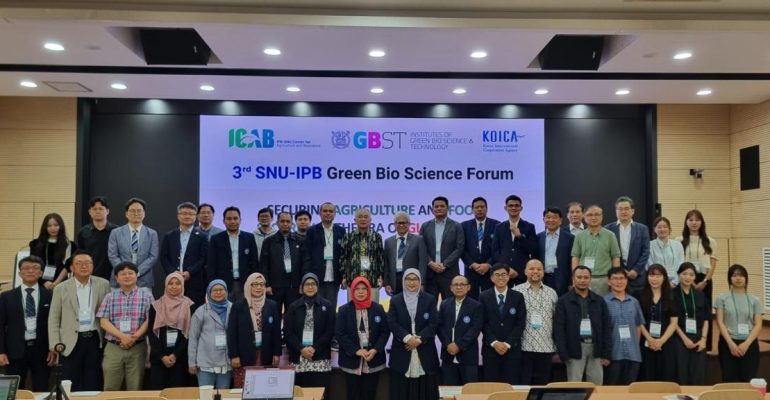
3rd IPB-SNU Green Bio Science Forum
:Securing Agriculture and Food Security in the Era of Global Crisis
The Institutes of Green Bio Science and Technology (GBST) at Seoul National University, led by Director General Prof. Tae-Jin Yang, successfully hosted the 2025 NICAB Workshop from July 23 to 25, 2025, at the IPB International Convention Center in Bogor, Indonesia.
This workshop was organized as part of the “Capacity Building for the Center for Agriculture and Bioscience of IPB University in Indonesia” project, a $11 million initiative led by GBST and supported by the Korea International Cooperation Agency (KOICA). The event aimed to strengthen joint research and educational cooperation in the agricultural and biosciences fields between IPB University and Seoul National University.
Held under the theme of “Establishing Advanced Research Instrumentation Infrastructure for Research, Education, and Public Service,” the three-day workshop gathered more than 300 participants, including representatives from the Indonesian Ministry of Higher Education, Science, and Technology, KOICA, IPB University, leading Indonesian universities, 16 Korean research equipment companies, Seoul National University, and experts from academia, industry, and government in both countries
At the opening ceremony, welcoming and congratulatory remarks were delivered by Director General Prof. Tae-Jin Yang (GBST, Seoul National University), Professor Agus Purwito (IPB University), and Professor Khairul Munadi (Ministry of Higher Education, Science, and Technology, Indonesia). The keynote speeches by Dr. Dadan Hindayana, Head of Indonesia’s National Nutrition Agency, and Mr. Changsu Choi, President of Gyeonggi Agro-fisheries Institute, drew significant attention with presentations on Indonesia’s free nutritious meal program and Korea’s eco-friendly school meal service model. The Rector’s Forum followed, where rectors from five major Indonesian universities engaged in in-depth discussions on sustainable financing models for university instrumentation centers and collaborative strategies for the successful establishment of NICAB.
The workshop also featured a dedicated session on the Inter-University Center for Excellence, where Indonesian university representatives shared experiences in collaborative research infrastructure and explored future opportunities for international cooperation, including with Korean institutions.
From the second day, Indonesian and Korean universities and companies shared research cases and cutting-edge technologies across four sessions, covering topics such as animal cell culture, food and bioscience analysis and diagnostics, and advanced laboratory environments. The exhibition booths were set up by 16 Korean bio and equipment companies and R&D institutions became a vibrant space for on-site exchanges and networking.
The final day featured field excursions to major research institutions, including IPBUniversity, the Bogor Botanical Garden, and the National Research and Innovation Agency (BRIN) of Indonesia, offering participants firsthand insights and opportunities to explore practical avenues for collaboration. In his welcoming remarks, Director General Prof. Tae-Jin Yang emphasized that “the establishment of NICAB is not merely about building facilities, but about creating a sustainable innovation platform centered on people, collaboration, and vision.” He further expressed his hopes that “through close academic and industrial cooperation between Korea and Indonesia, NICAB will grow into a hub for agricultural and bioscience research in both countries.”